T-TAP Professional Development Specialist

T-TAP PDS Instructions


General Instructions

The New York State Training and Technical Assistance Professional (T-TAP) Credential Professional Development Specialist (PDS) designation is the standard used to assure quality professional development for early childhood and school-age professionals. It recognizes a high level of professional achievement for providers of professional development.

The credential is required to access Education Incentive Program (EIP) dollars, Quality Scholars payments and to give OCFS credit for virtual training.

All professional development providers applying to become a T-TAP Professional Development Specialist must submit the written reflection application and participate in a video interview.

The T-TAP application and interview are an opportunity for you to present evidence of your abilities as a trainer. The application must specifically describe your knowledge and skills as they relate to those outlined in the credential’s T-TAP PDS Competencies for providers of group professional development.


Education and Experience

Your education and experience will be verified through The Aspire Registry. Please complete an individual professional profile in Aspire before applying for the credential. NYAEYC offers the T-TAP Credential Professional Development Specialist Designation for early childhood, school-age and family child care trainers. Please indicate which credential aligns with your education and work experience.

You must have an active trainer profile the meets one of the T-TAP PDS pathways.

Credential Designation

Please refer to the Qualification Pathway Chart above to determine your designation.

  • Early Childhood (provide group professional development for educators working in a birth-8 program – all modalities)
  • School Age (provide group professional development to educators working in a program serving children ages 5 and above i.e. after school program, youth program)
  • Family Child Care (provide group professional development to educators working in a family or group family child care program)
  • Higher Education (provide group professional development for educators working in a birth-8 program – all modalities)

Additional steps are required for the following designations:

  • Family Child Care
    You must authorize NYAEYC to verify your regulatory compliance history with the Office of Children and Family Services for the past five years. Please have your license or registration number ready to enter into the Intent to Apply form.
  • Higher Education Faculty
    You must provide a letter from the Dean or Head of the Early Childhood Department confirming that you are a full-time, tenured professor within the department with your Intent to Apply form.

*All applicants are encouraged to complete the Elevating Practice Course: A Reflective Learning Series for Professional Development Providers prior to applying for the credential.


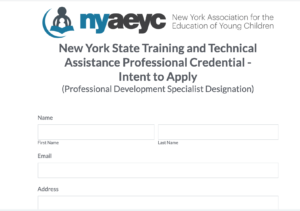
Intent To Apply Form

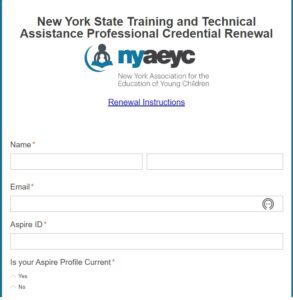
Once you have an active Aspire Professional Profile, complete the Intent to Apply Form.

You will supply basic contact information including your Aspire ID. The application should take no more than 15 minutes to complete.

Using information from your Aspire Professional Development Record, NYAEYC will determine your eligibility for the Credential. Candidates will be notified of their eligibility status within 10 business days.

Membership Requirement

To obtain and maintain your credential, you must hold an active membership in a recognized state or national early childhood organization. This ensures that credentialed professionals remain connected to current research, best practices, and professional standards within the field.

Credential Designation

Please refer to the Qualification Pathway Chart above to determine your designation.
Additional steps are required for the following designations:

  • Family Child Care Designation
    You must authorize NYAEYC to verify your regulatory compliance history with the Office of Children and Family Services for the past five years. Please have your license or registration number ready to enter into the Intent to Apply form.
  • Higher Education Faculty
    You must provide a letter from the Dean or Head of the Early Childhood Department confirming that you are a full-time, tenured professor within the department with your Intent to Apply form.

Written Reflection Application

Once your Intent to Apply form is received and all submitted information has been verified to meet the credential qualifications, you will receive an email with instructions for completing the Written Reflection Portfolio.

  • You will have 30 days from the date of that email to complete and submit this section.
  • Important Reminder: This email will include your link to access the digital written reflection.

Section 1: New York State Core Body of Knowledge (CBK) Professional Development Specialist Assessment

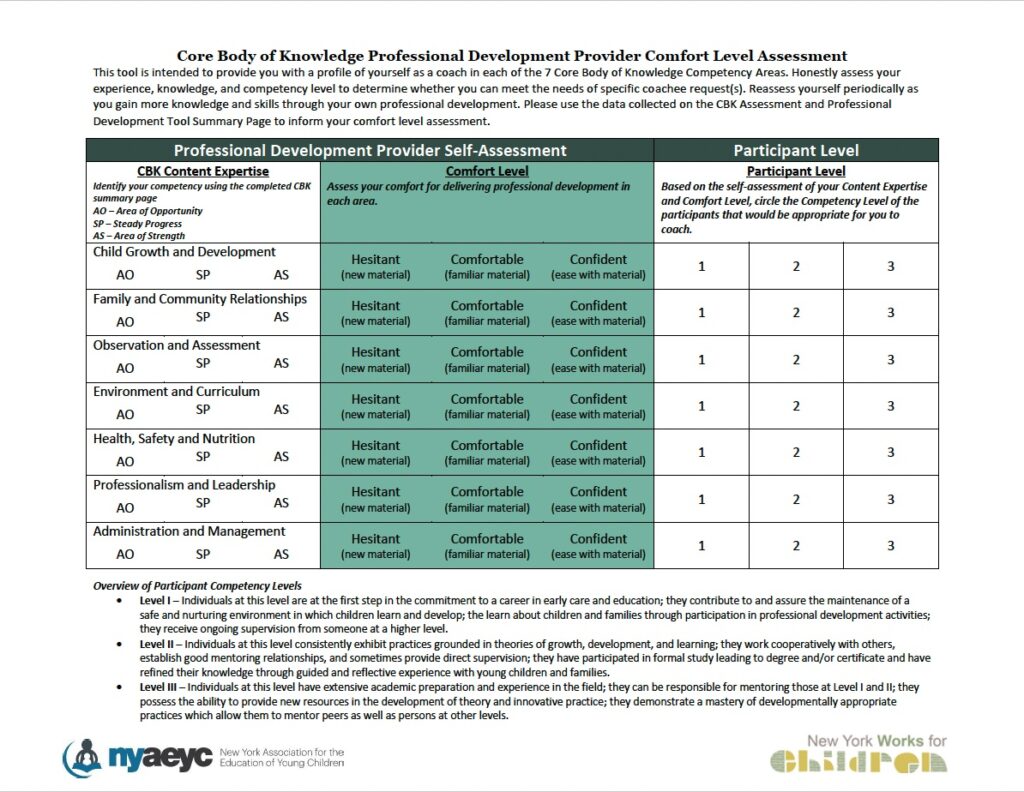
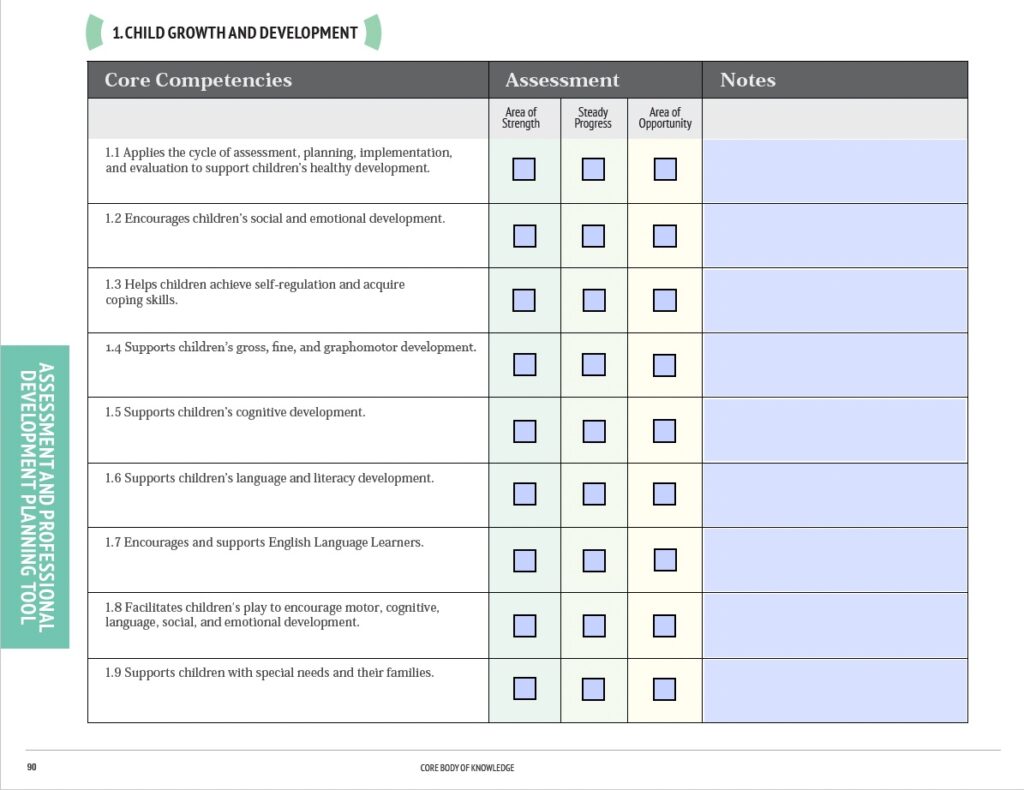
As an applicant for the T-TAP Professional Development Specialist, you need to have knowledge, skill, and professional experience in the Core Competency Areas in which you train.  Applicants will complete a self assessment using the New York State Core Body of Knowledge Professional Development Specialist Assessment Tool in a minimum of 3 Core Competency Areas.

Assessment Step 1: Review Each Section

There are 7 sections, each aligned with CBK areas.  Each section includes:

  • Core Knowledge (what you understand)
  • Essential Skills (what you can do)
  • Habits of Mind and Dispositions (how you approach your work)
  • Core Competencies (complex bundles of knowledge, skills, and behaviors; descriptors outline specific components of each core competency)

Assessment Step 2: Complete the Self-Assessment

Applicants must:

  • Assess Core Competency Area 1: Child Development Learning In Context
  • Choose a minimum of one personal strength Core Competency Area
  • Choose a minimum of one personal growth Core Competency Area

Work systematically through each section. Read each descriptor carefully and make a note of areas of strengths and areas of opportunity.  List thoughts and plans Be honest—this is a tool for growth, not evaluation.

For each Core Competency Area:

  • Rate your personal level of knowledge of the core competency
  • Reflect on your experience implementing that core competency as an early childhood educator responsible for the direct care and teaching of young children.
  • Note how recently and how often you have been training on that core competency.

Please refer to the tool for further instructions. This video also walks applicants through completing the assessment process.

Assessment Step 3: Use the Results

  • Identify areas you are well Prepared to train
  • Identify strengths and growth opportunities
  • Create a Personal Professional Development Plan

Practical Tips

  • Be honest and specific – this is for growth, not evaluation.
  • Use the CBK descriptors as your guide.
  • Document examples of your experience (e.g. “I’ve trained on observation and assessment for 5 years”).
  • For growth areas, think about resources, training or mentoring you need.

Section 2: Professional Development Sessions Submission

Building on the information provided in Section 1, this section focuses on your ability to reflect on a professional development session you have delivered. The purpose is to assess how clearly and thoroughly you articulate your responses to the reflection questions. The review process does not evaluate the content of your training, but rather the quality of your self-reflection.

Key Requirements:

  • Select a session you have delivered at least once and for which you have collected participant feedback.
  • It is strongly recommended to choose a session you have offered multiple times, as this will provide richer insights for reflection.

You will need to upload or enter the following:

  • Approved Aspire Course ID Number
  • PowerPoint slides with trainer notes OR a comprehensive training plan
  • Handouts distributed during the session
  • A blank copy of the evaluation tool used to assess content and delivery

In this section, you will demonstrate your ability to reflect on the process of creating and delivering group professional development. Your responses should relate specifically to the training session submitted in your application. Focus on your research, planning, adaptation, and strategies for engaging participants.

Please address the following questions:

  1. Planning and Adaptation
    Describe your process for planning a particular offering of this professional development session. How do you adapt content and instructional methods to meet the needs of your participants?
  2. Assessing Learning During the Session
    The evaluation you submitted measures participant learning at the end of the session. What strategies do you use to assess participants’ acquisition of the stated learning objectives throughout the training?
  3. Promoting Change in Practice
    Research shows that high-quality professional development leads to changes in behavior and practice. What specific strategies do you use to support this outcome?
  4. Reflecting and Revising
    If you were to deliver this session again, what would you do differently? How might you revise content or instructional design as a result of this reflective exercise?

Section 4: Attestation Statements

At the conclusion of your written reflection, you will review and sign the following statements to confirm your commitment to professional standards and the authenticity of your submission.

Professional Development Specialist Agreement

As a participant or holder of the New York State Training and Technical Assistance Professional Credential, I agree to:

  • Ethical Standards
    Present content aligned with the NAEYC Code of Ethics and use the Code to guide my own behavior.
  • Accuracy and Confidentiality
    Provide current, factual information that reflects best practices for adult learning.
    Maintain confidentiality of all participants.
  • Copyright Compliance
    Adhere to copyright laws. I will not use materials from other trainers or programs without written permission and/or proper acknowledgment.
  • Professional Competence
    Deliver professional development activities within the scope of my expertise.
    Stay current in my profession by actively pursuing ongoing professional development.
  • Respect and Inclusion
    Treat all participants fairly and respectfully, without discrimination.
    Present information that is inclusive and respectful of diverse cultures.
  • Sales and Promotion
    Not sell or promote products/services during training sessions unless directly related to the training content.
  • Collaboration
    Cooperate with other professionals to best serve early childhood educators, children, and families in New York.
  • Agency Standing
    Maintain good standing with NYAEYC partner agencies, including but not limited to:
    Office of Children and Family Services, SUNY Professional Development Program, New York Works for Children, and New York State Network for Youth Success.

Self-Reporting Obligations

As a credential holder, I understand that I must self-report within 48 hours any changes in status with a partner agency, including investigations, suspensions, or revocations.
Failure to self-report will result in permanent removal of credential status.

Consent

I understand my responsibilities and consent to partner agencies sharing status updates regarding my standing with their organizations.

Declaration of Authenticity

I declare that this submission is my original work, prepared to fulfill the purposes and objectives of the New York State Training and Technical Assistance Professional Credential – Professional Development Specialist process.
By signing, I attest that:

  • I am the author (or co-author) of the training content.
  • I delivered the training content to an audience.
  • I am the author of all written application entries.

Video Interview

Within 30 days of submitting your written reflection, your interview will be scheduled. The interview includes a combination of scenarios and discussion questions, which will be displayed on the screen and read aloud.

What to Expect

  • Scenarios are adapted from real trainer experiences and may describe challenging situations. In real life, you might choose not to proceed with a training under these circumstances; however, for the interview, please respond as if the training is moving forward.
  • Each scenario will use the same discussion prompts to guide the conversation. Your responses should address all topics, but you do not need to answer in order.
  • Timing:
    • You will have 12 minutes to reflect and respond to each scenario.
    • After the scenarios, there will be two follow-up questions. For these, you will have 5 minutes to reflect (camera off, microphone on) and 5 minutes to respond.
  • We encourage you to think out loud and let the reviewers know when you have finished your response.

Scenario Discussion Prompts

  1. What are the key tensions or dilemmas in this scenario, and how do they impact the learning environment?
  2. What facilitation strategies could be used to address the situation in real time and support the group moving forward?
  3. What would you do as the facilitator to maintain psychological safety, equity, and engagement?
  4. How could this moment be used to model best practices that participants can apply in their own work with children, families, or colleagues?

Competency Focus

The T-TAP PDS competencies in Areas C and D will be most heavily referenced during the interview. Candidates are strongly encouraged to review:

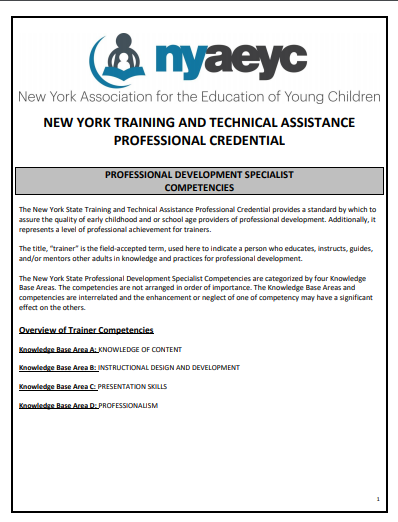
  • The T-TAP PDS Competencies
  • The NAEYC Code of Ethical Conduct for Early Childhood Adult Educators

Your responses should demonstrate your knowledge, skills, and dispositions as a Professional Development Specialist.


Scoring Rubric

Your written reflection and interview will be evaluated by two independent peer reviewers using the T-TAP PDS Scoring Rubric. This rubric measures the depth, breadth, and quality of your responses and is fully aligned with the T-TAP PDS Competencies.

Minimum Score Requirement:
Candidates must achieve a minimum score of 70% on both the written reflection and the interview to be eligible for credentialing.

Notification of Status:
Candidates will receive official notification of their T-TAP PDS status within 10 business days following the interview. Possible outcomes include:

  • Award
    Congratulations! You will receive information on how to maintain your credential.
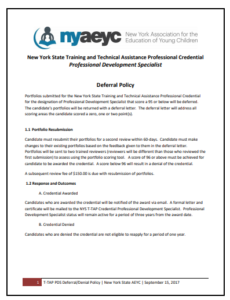
  • Deferral
    You will receive specific instructions or steps to complete before reapplying. The timeline is self-paced and depends on when you complete the required steps.
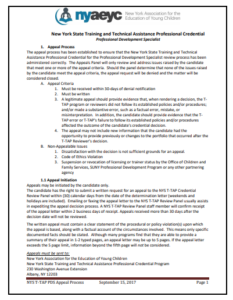
  • Denial
    Candidate is not eligible to reapply.

Scoring At A Glance

SectionComponentsMax Points
WrittenCBK Self-Assessment; PD Submission; PD Self-Reflection49
Interview3 Scenarios; 2 Discussion Questions; Professionalism63
Total112

Written Submission (49 points)

CBK Self-Assessment & Comfort Level (15 points). Three competency areas are scored (Child Development & Learning in Context is required). For each competency (0–5):

  • Completed Personal Competency & Experience.
  • Completed Training Experience.
  • Identified Areas of Strength & Opportunity.
  • Identified at least one action in PD planning notes.
  • Completed PD Content Levels.

Professional Development Submission (22 points). Criteria:

  • Title (0–2): present and representative of overall content.
  • Design (0–2): trainer notes with timing and slides that support objectives and duration.
  • Description (0–3): matches title and reflects session content.
  • CBK Areas Covered (0–2): identifies Core Competency area(s) that support description.
  • Learning Goal (0–3): supported by description and content.
  • SMART Objectives (0–3): all elements of SMART; align with description and content.
  • Bibliography/References/Resources (0–3): relevant, current, and valid.
  • Blank Evaluation (0–3): addresses content, trainer delivery, and professionalism.

PD Self-Reflection Question (12 points). Response scored 0–3 each:

  • Planning & adaptation: how you plan and adjust content/instruction to participant needs.
  • Ongoing assessment: how you assess participant learning throughout the session.
  • Practice change: strategies you use to ensure learning transfers to behavior/practice.
  • If repeating the session: what you would change and how reflective insights inform revisions.

Interview (63 points)

Scenarios (3 × 11 points). Across each scenario you are scored on four dimensions; together they sum to 11 points per scenario:

  • Identify the key tensions/dilemmas and how they impact the learning environment; strongest responses align to NYS/NAEYC frameworks (CBK, Code of Ethics).
  • Facilitation strategies used in real time to support the group (conflict resolution, emotional regulation, inclusive techniques).
  • Maintaining psychological safety, equity, and engagement.
  • Modeling best practices that participants can transfer to work with children, families, and colleagues.

Discussion #1 – Adult Learning & Theory (15 points). Scored across five criteria (0–3 each):

  • Intentionality
  • Knowledge of theory
  • Application to design
  • Impact on learners
  • Adaptability

Discussion #2 – Reflective practice (12 points). Scored across four criteria (0–3 each):

  • Self-awareness
  • Problem-solving
  • Adaptability & growth
  • Professional application

Strong responses explicitly reference NYS frameworks and the NAEYC Code of Ethics, demonstrate adult learning principles in action, and provide concrete, transferable strategies.

Fees and Payments

A fee is required to issue the Professional Development Specialist designation through the New York State Training and Technical Assistance Professional Credential. These fees are collected at two points:

  • Intent to Apply submission
  • Written Reflection Application submission

Payment Options:

  • Credit Card (Preferred)
    NYAEYC accepts and strongly encourages payment via MasterCard or Visa using the secure Stripe interface embedded in the Intent to Apply Form and Written Reflection Application.
  • Payment by Check
    If you choose to pay by check, include a check for the amount due.
    Checks should be made payable to:
    New York Association for the Education of Young Children
    Note: An additional $25 fee will be charged for any returned check.

Credential Fees:

Intent to ApplyWritten Application SubmissionResubmission Fee (1 part deferred)Resubmission Fess (2 parts deferred)
NYAEYC Members$100$350$250$350
Nonmembers$100$450$350$450
Fees are nonrefundable and subject to change.

Maintaining Your Credential

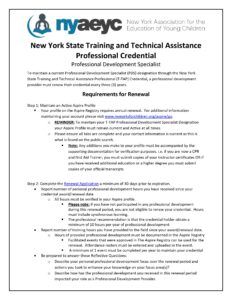
To maintain your Training and Technical Assistance Professional (T-TAP) Credential as a Professional Development Specialist, you must renew your credential every three years.

The renewal process ensures that you:

  • Participate in ongoing professional development.
  • Provide sufficient professional development to the field to remain an active trainer.
  • Keep your Aspire Profile current and accurate.

Renewal Guidelines

Step 1. Maintain an Active Aspire Profile

  • Your profile on the Aspire Registry requires annual renewal to ensure all tabs are complete and your contact information is current, as this is how your contact information is displayed on the public search.
    • Note: Any additions you make to your profile must be accompanied by the supporting documentation for verification purposes. For example, if you are now a CPR and First Aid Trainer, you must submit copies of your instructor certificates OR if you have received additional education or a higher degree you must submit copies of your official transcripts.

Step 2. Personal Professional Development

Remaining current in the field is paramount to providing high-quality group professional development.

  • You must attend at least one personal professional development session in each of the three years of your renewal period.
    • Our professional recommendation is that credential holders attend a minimum of 10 hours of personal professional development per year.
  • All hours must be documented and verified in your Aspire profile or through certificates of completion.
    • Note: If you have not participated in any professional development during the renewal period, you are not eligible to renew your credential. Fifty percent (50%) of the professional development must be synchronous learning.

Step 3. Active Trainer Status

Maintaining this credential requires you to actively provide training.

  • You must provide at least one training each year during your renewal period.
  • Trainings must be entered and approved in the Aspire Registry AND attendance rosters must be entered or uploaded in the event.
    • Note: If you have not provided any professional development during the renewal period, you are not eligible to renew your credential.

Step 4. Complete Renewal Application

  • Let NYAEYC know you would like to maintain your credential at least 30 days prior to expiration.
  • Be prepared to answer these reflective questions:
    • Describe your personal professional development focus over the renewal period and actions you took to enhance your knowledge on your focus area(s).
    • Describe how has the professional development you received in this renewal period impacted your role as a professional development provider.
    • Explain how you use reflective practice to reexamine training sessions, solve ethical and/or cultural dilemmas, and reflect on your own work. 
    • Describe any support, training, or coaching that would assist you in your role as a professional development provider.
  • Complete your Personal Professional Development Plan
    • As a holder of the T-TAP you have committed to engage in continuous learning and self-reflection.  Identify three core competency areas and/or credential competencies in which you intend to seek further study in the next three years and strategies you will use to implement your plan.
    • Revise the Personal Professional Development Plan you submitted as part of your application or last renewal, as applicable.
  • Sign the Training and Technical Assistance Professional Credential Professional Development Specialist Agreement
  • Pay the $100 renewal fee.
    • Note: All credential holders receive a six-month grace period before credentials are deactivated.

Information and Resources

Back to Top